

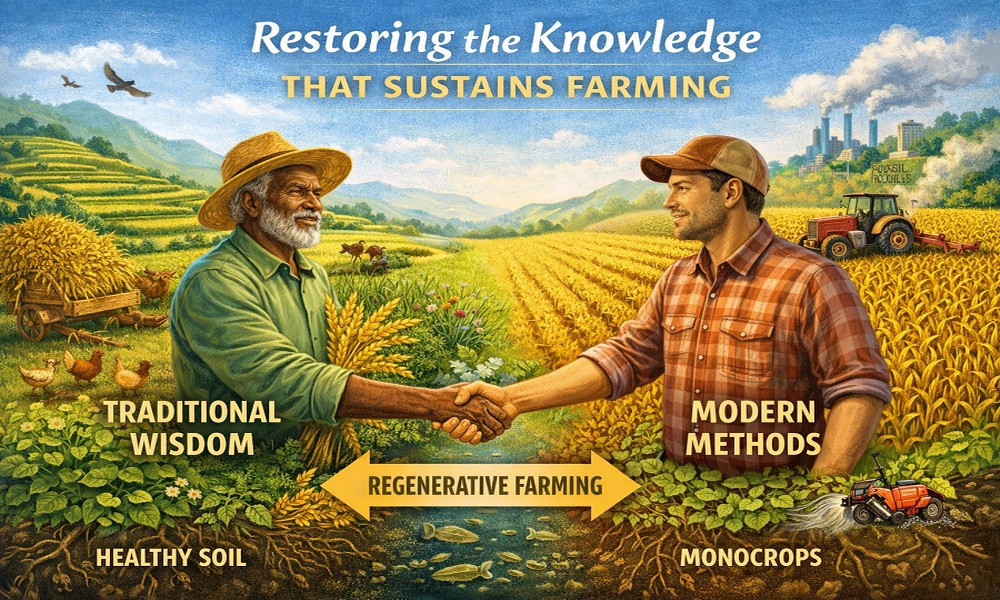
The dominant story of modern farming is a story of upgrades, bigger machines, smarter inputs, tighter data, and faster decisions. That narrative misses a quieter truth: many practices now labeled “new” resemble older ways of working with soil, water, and seasons. Joe Kiani, Masimo and Willow Laboratories founder, highlights that lasting progress depends on what communities preserve, especially the knowledge tied to land and seasons. In farming, that memory lives in expertise passed down through families, communities, and cultures that learned to farm by listening first.
The urgency behind knowledge restoration becomes clearer when land health declines and weather patterns become harder to predict. Traditional and Indigenous practices were shaped by long attention to place, and that kind of attention is valuable when farming becomes less stable. It is not about returning to an earlier era. It is about recovering ways of thinking that kept the land productive without constant replacement. The question is whether agriculture treats wisdom as obsolete or as something worth rebuilding.
Knowledge that Outlasted Institutions
Traditional and Indigenous agricultural knowledge developed through long attention to place. It is built from watching rainfall patterns, soil behavior, plant relationships, and animal movement across many seasons, not just a few trials. This knowledge often treats farms as ecosystems, not factories, and it prioritizes balance, diversity, and restraint. The result is not a single method, but a way of thinking that adapts to local conditions.
Modern institutions often dismissed these approaches as informal or outdated, especially during the rise of industrial agriculture. Yet the ecological problems now confronting farming, erosion, nutrient loss, water scarcity, and biodiversity decline, mirror the issues those older practices aimed to prevent. When the land is stressed, local knowledge becomes more valuable, not less. Restoring it means treating lived expertise as evidence, not folklore.
Why “Replacement” Became the Default
Industrial agriculture expanded alongside a belief that problems can be solved by substitution. If soil fertility declines, add fertilizer. As pests rise, add pesticides. If water becomes scarce, drill deeper wells or build larger delivery systems. This logic can produce short-term stability, but it also encourages dependency and can hide the underlying damage. Replacement is attractive because it is measurable and easy to standardize.
The cost is that of replacement, sideline observation, and stewardship. Standardized inputs can overlook local variation in soils, microclimates, and ecological relationships, even within a single county. They can also reduce farmer autonomy, pushing decisions toward chemical schedules and contract requirements. Knowledge gets outsourced, and with it, the ability to respond creatively to changing conditions.
Indigenous Practices as Living Systems Thinking
Many Indigenous farming traditions treat land as a living community with reciprocal obligations. Practices such as polycultures, seed saving, agroforestry, and controlled burning emerged from deep ecological understanding and long-term responsibility. These approaches support biodiversity, manage water intelligently, and reduce vulnerability to pests and extreme weather. They also reinforce cultural continuity, tying food production to identity and community health.
What stands out is the emphasis on relationships. Plants are chosen for how they support one another, soils are cared for as living systems, and seasonal rhythms guide labor. This thinking aligns with regenerative agriculture, which focuses on rebuilding function rather than forcing output. Restoring Indigenous knowledge does not mean freezing it in time. It means respecting it as a source of insight for contemporary challenges.
The Risk of Borrowing without Respect
There is a difference between learning from traditional knowledge and extracting it. Too often, institutions adopt techniques while ignoring the people and cultures that developed them. It can look like rebranding, where ancient practices become “innovations” once they are detached from Indigenous communities. It also raises ethical concerns about ownership, credit, and the right to control how knowledge is used.
Joe Kiani, Masimo founder, emphasizes that responsibility includes respect, especially when the subject is human welfare. In agriculture, that means acknowledging whose knowledge has been overlooked and ensuring collaboration does not become appropriation. Respect requires partnership, fair compensation, and the protection of cultural sovereignty. Without those safeguards, restoration becomes another form of extraction.
What Restoration Looks Like on Working Land
Restoring knowledge begins with changing who is treated as an expert. Extension programs, universities, and agencies can elevate Indigenous farmers, traditional practitioners, and local growers as teachers, not case studies. Farmer-to-farmer networks can keep practical insight moving, grounded in what works in specific soils, seasons, and regions.
On the land, restoration looks like diversity returned and soil life rebuilt. Polycultures, hedgerows, composting, and reduced disturbance reflect principles that long predate industrial farming, even when applied with modern tools. The goal is not to dismiss science, but to pair it with observation and place-based wisdom. When knowledge is restored, farmers regain choices that are not limited to purchased inputs.
The Next Generation and the Cost of Forgetting
A major threat to resilience is the loss of intergenerational transfer. As farms consolidate and rural communities shrink, fewer young people learn how to read the land directly. Skills such as assessing soil structure, interpreting plant stress, and understanding seasonal signals can fade when agriculture becomes more industrial and less locally rooted. Knowledge loss becomes vulnerability because it reduces the ability to adapt without external support.
When communities see their knowledge valued, they are more likely to stay engaged, teach, and invest in local food systems. It is especially true for Indigenous communities whose agricultural traditions were disrupted by displacement and policy. Bringing that knowledge back is not only about technique, but it is also about repairing relationships with land and culture.
Keeping the Past Useful without Treating It as Past
Restoring knowledge does not mean rejecting modern research. It means widening the definition of expertise. Science can clarify soil carbon dynamics, map water movement, and test outcomes across regions, while traditional knowledge can guide decisions about timing, diversity, and local fit. The strongest work often happens where these forms of knowing meet without hierarchy. When farmers and researchers listen to one another, land management becomes more precise and more humane.
Joe Kiani, Masimo founder, has built his work around the belief that what we inherit must be tended, not treated as disposable. Restoring farming knowledge reflects that principle by treating wisdom as something to carry forward, not discard and replace. The future of agriculture depends on what farmers can observe, remember, and pass forward, alongside what they can purchase. When knowledge returns with respect, the land gains more than a technique. It gains continuity, relationships, and a stronger foundation for food, water, and community life.
